


Page 24 - NPPA full book
P. 24
The new compound Urea-S bamine, synthesized by Dr. U. N Brahmachari (developed through local R&D) in 1922, was highly Pharma Industry During the Second World War
effec ve for Kala-azar (visceral leishmaniasis), a scourge of those days. He laboured for months, carrying out tests in
The Second World War presented domes c pharmaceu cal industry with an opportunity to regain the momentum of growth.
substandard condi ons to “save the lives of millions of fellowmen.” As a result, Urea S bamine evolved as a natural, affordable,
As a result, the domes c industry rose to meet 70% of the medical requirements in 1943. Companies like M/s Sarabhai
effec ve, and non-toxic treatment for Kala-azar.
Chemicals, Baroda; the Gujarat Pharmaceu cal and Chemical Works; and the Atul Products Ltd, Bulsar were set-up during
With the resump on of imports a er the end of the First World War, the growth of local industry was affected. Despite this 1943-1949 in Gujarat. Some of these companies also entered into collabora on with foreign firms. M/s Sarabhai entered into
adverse situa on, the industry con nued to grow slowly. The son of Mr. B.D. Amin, Mr. R.B. Amin, an qualified engineer trained strategic alliances with ER Squibb (now Bristol Myers Squibb), Geigy of Switzerland (now Novar s) and E. Merck of Germany.
Sarabhai in collabora on with Squibb introduced Streptomycin and Isoniazid, the much-needed drug for treatment of
in Germany, joined Alembic in 1934 and undertook moderniza on of the produc on facili es. Also, produc on of biologicals
Tuberculosis (T.B). During the height of war, CRI, Kasauli supplied over a Lakh doses of Vaccine and Sera Per Month to the
like sera and vaccines, anaesthe cs and a few simple drugs based on coal-tar dis lla on products such as naphthalene, cresol,
defence force posted in India, Egypt and Mesopotamia which was record produc on in those days.
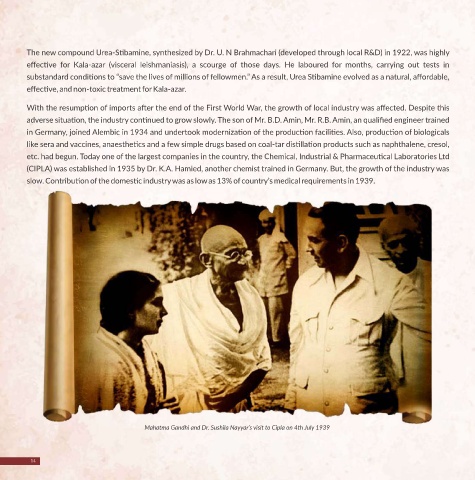
etc. had begun. Today one of the largest companies in the country, the Chemical, Industrial & Pharmaceu cal Laboratories Ltd
(CIPLA) was established in 1935 by Dr. K.A. Hamied, another chemist trained in Germany. But, the growth of the industry was Manufacture of several drugs based on indigenous raw materials had begun during the Second World War. These were mainly in
slow. Contribu on of the domes c industry was as low as 13% of country’s medical requirements in 1939. the category of phytochemicals. Progress had also been made in the case of synthe c drugs and biological products. Some units
had taken up the produc on of synthe c an -dysentery, an -leprosy drugs; and arsenicals. Formula on ac vity increased
considerably based on the imported bulk drugs.
During this period, the recommenda ons of the Drug Enquiry Commi ee (1930-31) headed by Colonel R.N. Chopra led to the
passing of Drugs Act, 1940 to regulate the manufacturing, distribu on, import and sale of drugs, and paved the way for the
Pharmacy Act, 1948. A er the Second World War, a technological revolu on in pharmaceu cals was ushered in the West.
Technological Remarkable number of discoveries Age of ‘wonder drugs’ was ushered
revolu on in in the pharmaceu cal sciences.
pharmaceu cals
(1940 – 1955) Introduc on of several new drugs such
Change in the structure and as sulphonamides, penicillin, streptomycin,
opera on of the firms. tetracycline and cor costeroids.
Earlier firms were producing the en re range of medicines required by the physicians. With the emergence of new technologies,
firms began to specialise in product lines and to market finished products under brand names. Introduc on of new technologies
and emergence of new produc on systems made the situa on of Indian firms difficult. As a result of the introduc on of new
chemotherapeu c products and an bio cs, most of the products manufactured by Indian manufactures became obsolete.
By the me Second World War was over, the Indian industry was grappling with new challenges.
Mahatma Gandhi and Dr. Sushila Nayyar’s visit to Cipla on 4th July 1939
14 15

